

Inside an MRI Emergency — What Happens After the Incident Begins
The Question That MRI Safety Training Rarely Addresses
MRI professionals receive thorough training in prevention — and for good reason. Preventing projectile incidents, reducing the risk of thermal injury, managing implant-related contraindications, and maintaining strict access control are all foundational to a safe imaging environment. The field has invested significantly in building those competencies, and the progress that investment has produced is real.
What receives considerably less structured attention is what happens after a preventive measure fails — specifically, what the operational reality of an active MRI emergency looks like and how well most facilities are actually prepared to manage it. MRI emergencies are clinically complex, fast-moving, and constrained by the physical and operational characteristics of the scanning environment in ways that standard hospital emergency frameworks do not account for. Understanding those constraints — and building response systems around them — is as important to patient safety as the prevention protocols that precede them.
Why MRI Emergencies Don’t Follow Standard Emergency Logic
In most hospital settings, emergency response is built around two core assumptions: that staff can reach the patient quickly, and that standard emergency equipment can be brought to the scene without restriction. Speed and access are the foundations on which those response frameworks rest, and in most clinical environments, both are available.
The MRI environment systematically challenges both assumptions. The magnet room operates under a set of physical and operational constraints that have no equivalent elsewhere in the hospital:
- Ferromagnetic restrictions that exclude the majority of standard emergency equipment from the room
- Controlled access protocols that limit who can enter Zone IV and under what conditions
- Acoustic isolation that reduces how effectively sound — including a patient’s voice or a call for help — travels beyond the suite walls
- Physical separation between the control room and the magnet room that introduces response delays
- Equipment compatibility requirements that demand verification before anything enters the scanning environment
These are not obstacles that can be overcome through faster reaction times or better staff training alone. They are fixed features of the MRI environment, and any realistic emergency response plan must be built around them rather than around the assumption that standard hospital response workflows will translate.
The First Moments of an MRI Emergency
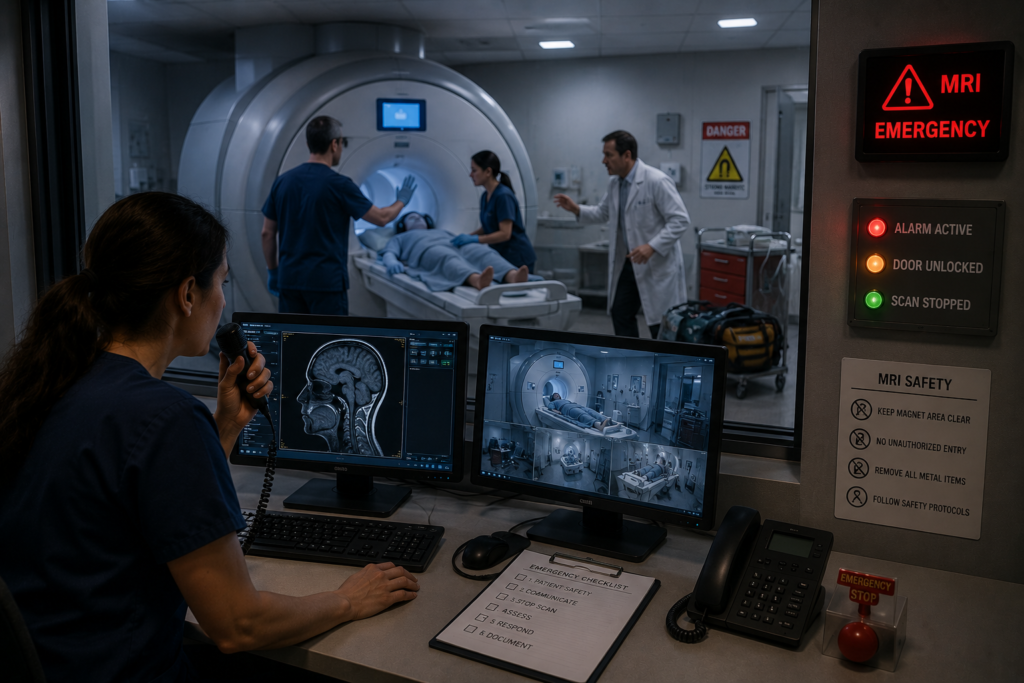
When an MRI emergency begins — whether a patient collapse, a panic response, a fall, a projectile incident, an oxygen-related crisis, or a quench event — the operational demands arrive simultaneously and without a ramp-up period. The technologist must rapidly assess patient stability, determine whether the patient can be safely moved, evaluate whether immediate evacuation is necessary, and manage equipment access decisions, all while initiating communication with additional responders whose arrival time may be uncertain.
The weight of those initial decisions falls heavily on whoever is present in the control room at the moment the emergency begins. In many facilities, that is a single technologist — and the direction that response takes in the first thirty to sixty seconds has a measurable effect on how the situation develops from that point forward. Protocols that are unclear, communication systems that require extra steps to activate, or role assignments that haven’t been rehearsed all introduce friction at exactly the moment when friction is most costly.
What happens first tends to set the trajectory for everything that follows. That reality places a particular premium on preparation that reflects how MRI departments actually operate — not how they operate under ideal conditions.
Communication Under Pressure in a Constrained Environment
Communication is consistently one of the most underestimated factors in emergency response, and it is particularly consequential in the MRI environment. In ordinary circumstances, communication between clinical staff feels straightforward. Under the acute stress of an unfolding emergency, in a physically isolated environment with noise, room barriers, restricted sightlines, and compressed decision timelines, even basic communication can degrade quickly and significantly.
The structural features of MRI suites compound this challenge in specific ways:
- Physical isolation between the magnet room and control area limits how effectively verbal communication travels between them
- Background noise during scanning can mask a patient’s attempts to communicate distress
- Restricted access means that staff responding from outside the suite cannot simply enter; they must confirm safety clearance first
- Workflow interruption during an emergency can disrupt the communication patterns that staff rely on during routine scanning
When staffing is reduced — a single technologist managing the suite, or on-site support that is not MRI-trained — the communication challenge intensifies further. The fewer people available, the more precisely each communication pathway must function, because there is less redundancy available to catch failures in the chain.
The Problem of Not Being Able to Leave the Patient
One operational reality that emergency planning frequently overlooks is the scenario in which the technologist cannot physically leave the patient to summon help or coordinate a response. This is not a rare edge case — it arises across a range of clinical situations that MRI technologists encounter with some regularity.
A patient experiencing physical distress may require continuous support and cannot be left unattended. A patient with significant mobility limitations may need assistance that the technologist cannot safely interrupt. A panic response inside the bore may require the technologist’s continuous presence to prevent the patient from making sudden movements that could cause injury. In each of these scenarios, the technologist’s immediate priority is the patient in front of them — but their ability to activate additional help, communicate with staff outside the suite, or manage the response without assistance is simultaneously compromised.
In these moments, the critical operational question is not whether something went wrong, but how quickly adequate help can realistically be reached without the technologist leaving the patient. The answer to that question depends entirely on the communication systems, visibility tools, and escalation protocols that are already in place — because there is no time to develop them once the situation is underway.
The Operational Role of In-Room Visibility
Visibility into the MRI suite is most often discussed in terms of patient comfort — giving patients a sense of connection to staff outside the room during what can be an anxiety-inducing experience. That is a legitimate benefit, but it describes a fraction of what in-room visibility actually provides from an operational standpoint, and it is a framing that undersells the clinical significance of the capability.
During an emergency, the ability to quickly and accurately understand what is happening inside the magnet room — patient condition, positioning, movement, environmental status, and whether additional personnel have entered the space — directly affects how effectively the response can be coordinated. A technologist managing an emergency from the control room, or a remote technologist attempting to assess a situation from off-site, can respond more effectively and more rapidly when they have clear, real-time awareness of the room’s status.
This becomes even more operationally significant as remote scanning expands. When the technologist managing a scan is not physically present in the facility, the visibility and communication infrastructure connecting them to the on-site environment becomes the primary mechanism through which they can detect, assess, and respond to an emerging patient safety concern. In that context, in-room visibility is not a supplementary feature — it is a core component of the remote scanning safety framework.
What Effective Emergency Preparation Actually Looks Like
Strong emergency response in the MRI environment is not primarily a function of composure under pressure or individual clinical instinct, though both matter. It is a function of systems — the quality and clarity of the protocols, communication tools, role assignments, and rehearsed workflows that staff can rely on when an emergency removes the conditions for calm, deliberate decision-making.
Facilities that are genuinely well-prepared for MRI emergencies tend to share a set of common characteristics:
- Scenario-based drills that reflect the actual physical and staffing conditions of the department, not theoretical ideal setups
- Regular workflow reviews that identify gaps between documented protocols and how the department actually functions under pressure
- Clearly defined escalation pathways that all relevant staff have reviewed and practiced
- Explicit role assignments that specify who responds, in what sequence, and with what authority
- Communication systems designed for the MRI environment that function reliably when standard communication is compromised
- Equipment readiness protocols that account for ferromagnetic restrictions and maintain access to MRI-compatible emergency tools
- Staffing assumptions that reflect realistic shift configurations, including low-staffing periods and solo-technologist scenarios
The standard against which these preparations should be measured is not whether they function smoothly during a tabletop review. It is whether they hold up when one person is managing a distressed patient, another hasn’t been trained in MRI-specific restrictions, the environment is loud, and the situation is developing faster than the protocol anticipated.
Conclusion
MRI emergencies are operationally distinct from other hospital emergencies in ways that matter — and those distinctions demand a response framework built specifically around them. The constraints that define the MRI environment do not suspend themselves during an emergency; they are often the very factors that make an already difficult situation harder to manage.
The facilities best positioned to protect patient safety when an emergency occurs are those that have moved beyond treating response planning as an afterthought to prevention. They have examined what their department looks like under pressure, identified where their protocols break down, built communication and visibility infrastructure suited to the environment, and ensured that the people responsible for responding have practiced doing so under conditions that reflect reality.
Prevention remains essential. But in an environment as operationally complex as the MRI suite, the ability to respond effectively when prevention is not enough carries equal clinical weight — and it deserves equal preparation.
User: Sound Imaging Inc.
Website: www.SoundImaging.com
Email: Support@soundimaging.com